

BY SUZY BOURGET
If you’ve made your way here, welcome.
Sit down, get cozy, and let’s talk like old friends.
This space has been growing inside me for a long time. It’s where I can share the things I’ve learned, the things I’m still learning, and the things that make life feel heavy or beautiful, sometimes both at once.
Most of all, this blog is about connection.
About feeling seen.
About knowing you’re not alone in whatever season you’re in.
You’ll find stories here, real stories.
The kind that come from the heart, shaped by Northern Ontario skies, long drives, quiet lakes, and all the people who’ve walked in and out of my life.
You’ll find laughter, honesty, and a little bit of that “Suzy sparkle” I can’t help but sprinkle everywhere.
I don’t have all the answers.
But I do have life experiences, a lot of resilience, and a heart that refuses to stay quiet when there’s something worth saying.
So here’s to new beginnings, and to letting our stories matter.
With love,
Suzy Bourget
©Suzy Bourget
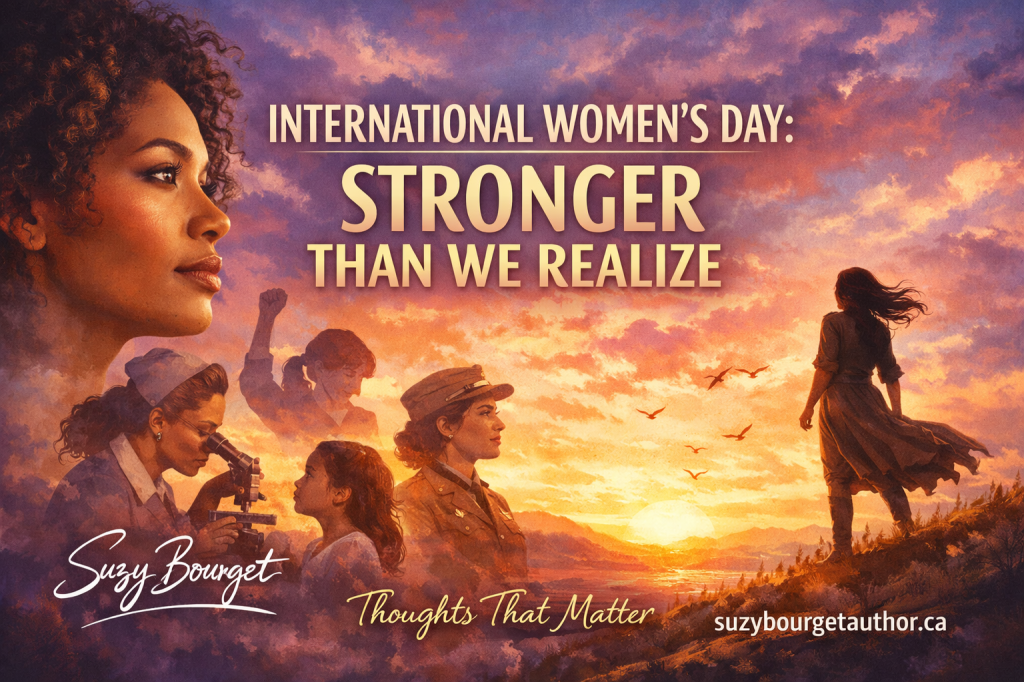
INTERNATIONAL WOMEN’S DAY: STRONGER THAN WE REALIZE… March 8, 2026
Every year on International Women’s Day, the world pauses to recognize the strength, resilience, and achievements of women.
But for many of us, the real meaning of this day isn’t found in speeches or social media posts.
It’s found in the quiet battles women fight every day.
It’s the single mother who keeps going when she’s exhausted.
It’s the woman who leaves a relationship that no longer feels safe.
It’s the grandmother who holds a family together with love and wisdom.
It’s the young girl learning that her voice matters.
Women carry entire worlds inside them, responsibilities, hopes, fears, and dreams, often while making it look effortless.
History shows us that progress for women did not happen by accident. It happened because brave women before us stood up, spoke out, and refused to accept limits placed on their lives.
Women like Rosa Parks, who quietly changed the course of civil rights history with one act of courage.
Or Marie Curie, who broke scientific barriers in a world that believed women didn’t belong in laboratories.
Or Mary Edwards Walker, who refused to accept the roles society assigned to women.
Their courage created opportunities many of us now take for granted.
But International Women’s Day is not only about famous women.
It’s about all women.
It’s about the quiet strength that often goes unnoticed.
The friend who listens when someone is struggling.
The coworker who lifts others up instead of competing.
The woman who chooses kindness even when life has been hard.
Science even tells us something interesting about resilience. Studies in psychology show that when people face adversity, supportive communities and strong social bonds significantly improve emotional recovery. Women often build and maintain these networks naturally, strengthening not only themselves but the people around them.
In other words, the strength of women doesn’t just change their own lives.
It changes entire communities.
So today, take a moment to appreciate the women in your life, mothers, daughters, friends, sisters, mentors.
And if no one has said it to you today:
Your strength matters.
Your voice matters.
Your story matters.
And the world is better because you are in it.
With love
©️Suzy Bourget
suzybourgetauthor.ca

WHEN YOU CHOOSE PEACE, IT COMES WITH A LOT OF GOODBYES…. Feb. 24, 2026
There comes a moment in life when you realize peace isn’t something you find.
It’s something you choose.
And no one really tells you that choosing peace often means saying goodbye, not just to people, but to versions of yourself you once needed to survive.
I used to think peace would feel loud. Victorious. Like fireworks after a long battle.
But real peace is quieter than that.
It feels like stepping away from arguments you could easily win.
It looks like not explaining yourself anymore.
It sounds like silence where chaos used to live.
And sometimes… it feels lonely at first.
Because peace changes your brain before it changes your life.
The Science Behind Letting Go
Our brains are designed for familiarity, not happiness.
The human brain runs heavily on something called the limbicsystem, the emotional center responsible for survival. Its job is simple: keep us safe by repeating what is known, even if what’s known is stress, conflict, or emotional exhaustion.
That’s why we often stay in situations that drain us. The brain interprets familiar discomfort as safer than unfamiliar calm.
When you begin choosing peace, your brain actually goes through a rewiring process called neuroplasticity, the brain’s ability to form new neural pathways.
Every time you:
- walk away instead of reacting,
- set a boundary,
- choose rest over proving yourself,
- or stop chasing validation,
you weaken old stress pathways and strengthen calmer ones.
But here’s the part no one warns you about:
Your nervous system may interpret peace as loss before it recognizes it as healing.
Why Peace Requires Goodbyes
Choosing peace often means saying goodbye to:
- constant explaining,
- people who only understood the old you,
- environments fueled by drama,
- habits built around survival instead of growth.
Your brain releases chemicals like cortisol during stress, the fight-or-flight hormone. Over time, some people become neurologically accustomed to that state. Chaos becomes chemically familiar.
So when calm enters your life, it can feel strange… even uncomfortable.
You’re not doing it wrong.
You’re detoxing from stress.
And just like any detox, there are withdrawals.
The Grief No One Talks About
Peace carries a quiet grief.
You grieve conversations you’ll never have.
You grieve being misunderstood.
You grieve the hope that some people might change.
But something beautiful happens at the same time.
As cortisol decreases, the brain increases production of serotoninanddopamine, chemicals linked to emotional stability, clarity, and well-being.
You begin to sleep deeper.
Think clearer.
React softer.
Breathe easier.
Your brain stops preparing for danger and starts allowing joy.
Becoming Someone New
When you choose peace, you don’t just lose things.
You gain space.
And the brain loves space.
The prefrontal cortex, the part responsible for reasoning, empathy, and decision-making, becomes more active when we are calm. This means peace literally makes you wiser, more patient, and more emotionally regulated.
You aren’t becoming cold.
You’re becoming regulated.
You aren’t giving up on people.
You’re choosing yourself.
The Truth About Peace
Peace isn’t the absence of love.
It’s the absence of struggle where love should have lived.
And yes, it comes with goodbyes.
But every goodbye creates room for something your nervous system has been quietly asking for all along:
Safety.
So if your life feels quieter lately…
If your circle feels smaller…
If you find yourself protecting your energy instead of explaining it…
You are not losing your world.
You are teaching your brain, and your heart, a new way to live.
And that is not an ending.
That is healing.
©️Suzy Bourget
YOUR NERVOUS SYSTEM DOESN’T KNOW THE DIFFERENCE BETWEEN A MEMORY AND REALITY Feb. 17, 2026
The strangest part of healing isn’t the pain.
It’s the moment you realize your body is reacting to something that isn’t even happening anymore.
You can be standing in your kitchen, holding your coffee, on an ordinary Tuesday morning… and suddenly your chest tightens. Your stomach drops. Your heart races. Nothing is wrong. Nothing is happening.
But your body doesn’t know that.
Because your nervous system remembers.
There was a time in my life when I thought I was broken. I would feel waves of anxiety for no logical reason. A smell, a song, a tone of voice, even silence could pull me somewhere I didn’t want to go. I would tell myself, this is ridiculous. You’re fine now. That’s over.
But my nervous system hadn’t caught up yet.
What I didn’t understand then, but understand now, is that the nervous system doesn’t operate on logic. It operates on survival.
When something painful or traumatic happens, your brain stores it, not just as a memory, but as a pattern. It remembers the feeling. The danger. The helplessness. And its job, above all else, is to protect you from ever feeling that way again.
So when something even slightly resembles the past, your body reacts first.
Not because you’re weak.
Not because you’re dramatic.
But because your nervous system thinks it’s keeping you safe.
Your body doesn’t know the difference between then and now.
And that realization changed everything for me.
Because instead of judging myself, I began to understand myself.
Healing isn’t about forcing yourself to “get over it.” Healing is about teaching your nervous system that the danger has passed. That you survived. That you are safe now.
And that takes time.
More time than people realize.
Sometimes healing looks like doing nothing more than sitting with yourself and breathing through the moment. Sometimes it looks like recognizing a trigger and not blaming yourself for it. Sometimes it looks like simply not abandoning yourself the way others once did.
Your nervous system is not your enemy.
It is the part of you that never stopped trying to protect you.
And slowly, gently, it learns.
It learns that you are no longer there.
It learns that you are no longer powerless.
It learns that you made it through.
There will come a day when something that once would have shattered you… barely touches you at all.
Not because it didn’t matter.
But because you healed.
And that is one of the quietest, strongest victories you will ever experience.
With love,
©️Suzy Bourget
suzybourgetauthor.ca
JUST GET TO THE NEXT MINUTE (PLEASE READ IF YOU’RE STRUGGLING RIGHT NOW) Feb. 8, 2026
Depression doesn’t always look like sadness.
Sometimes it looks like exhaustion.
Sometimes it looks like numbness.
Sometimes it looks like surviving quietly while nobody realizes how much effort that takes.
When it gets bad, really bad, I don’t tell myself to fix everything.
I make it smaller.
If it’s severe, I tell myself:
Just get to the next minute.
And there’s science behind why this works.
When you’re depressed, the part of your brain responsible for threat detection, the amygdala, becomes overactive. At the same time, the prefrontal cortex, the part that helps you think clearly, plan, and regulate emotions, becomes less active. Your nervous system shifts into survival mode.
In survival mode, your brain isn’t built to solve your whole life.
It’s built to get you through right now.
When you focus on just the next minute, you reduce overwhelm. You calm your nervous system. You give your brain something manageable. And slowly, your prefrontal cortex begins to come back online.
You are literally helping your brain stabilize itself.
If it’s not quite that heavy, I tell myself:
Just get to the next hour.
And if it’s just a dark day, I tell myself:
Just get to tomorrow.
Because emotions are chemical states.
And chemical states change.
Stress hormones rise, and they fall.
Brain activity shifts, and it recovers.
Feelings that feel permanent are often temporary brain states.
You don’t have to win today.
You don’t have to solve today.
You just have to stay.
Minute by minute.
Hour by hour.
Day by day.
That isn’t weakness.
That’s neuroscience.
That’s survival.
That’s strength.
And if you’re reading this and barely hanging on, please know there is help and there are people who care deeply about you, even if your brain is telling you otherwise.
In Canada, you can call or text 988 any time, day or night.
You do not have to be in crisis to reach out. You just have to be human.
With love
©Suzy Bourget
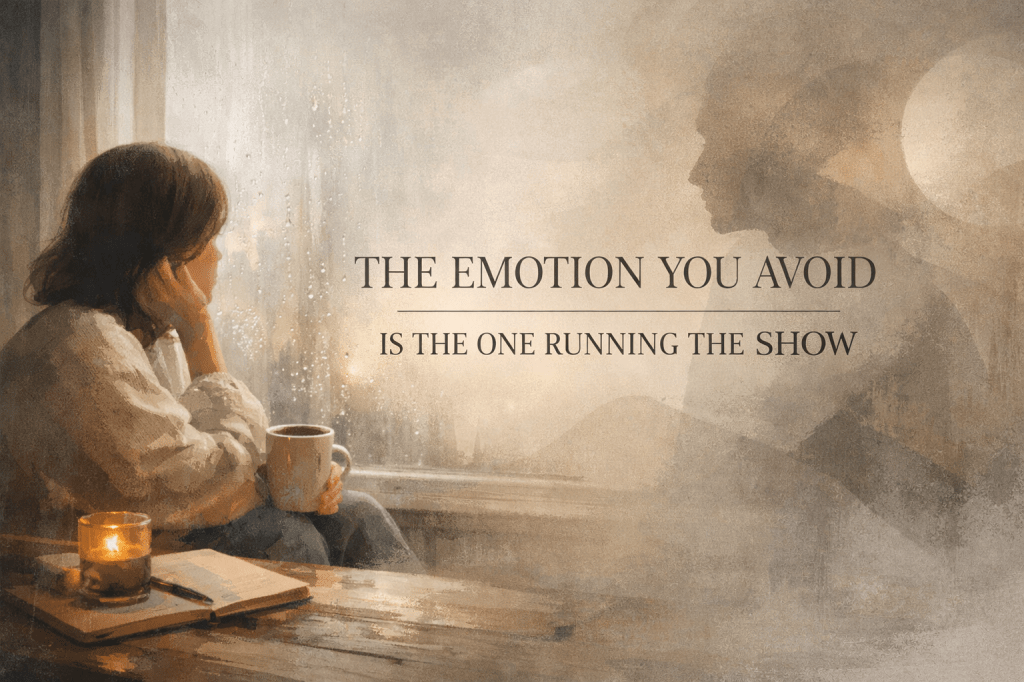
THE EMOTION YOU AVOID IS THE ONE RUNNING THE SHOW – Feb.01, 2026
There’s usually one emotion we don’t want to look at.
Not because we’re weak, but because it feels inconvenient. Messy. Too big.
So we tuck it away. Stay busy. Stay pleasant. Stay distracted.
And then we wonder why we feel restless, reactive, or exhausted for no clear reason.
Here’s the truth most of us were never taught:
The emotion you avoid doesn’t disappear. It takes control.
I didn’t realize this until I started paying attention to the patterns instead of the problems.
The moments I snapped for no reason.
The days I felt heavy without knowing why.
The impulse to fix, soothe, buy, explain, or retreat, without understanding what I was really responding to.
It wasn’t anger I was dealing with.
It was grief I hadn’t named.
It wasn’t anxiety.
It was resentment I’d convinced myself I wasn’t “allowed” to feel.
When we refuse to feel something fully, it doesn’t go quiet, it goes underground.
And from there, it drives our choices, our relationships, even our spending.
Avoided sadness turns into numbness.
Avoided anger turns into self-blame.
Avoided fear turns into control.
Not because we’re broken, but because emotions need acknowledgment before they release their grip.
What changed everything for me wasn’t “fixing” the feeling.
It was noticing it before I reacted.
Before the purchase.
Before the shutdown.
Before the over-explaining.
I started asking myself one simple question:
“What am I actually feeling right now?”
Not what I should feel.
Not what feels more polite or productive.
Just what’s true.
Sometimes the answer surprised me.
Sometimes it humbled me.
But every time, it gave me my power back.
Because when you can name a feeling, it stops running the show from behind the curtain.
You don’t have to dive into it all at once.
You don’t have to analyze your entire past.
Just notice.
That tightness.
That urge.
That familiar emotional detour.
The emotion you’re avoiding isn’t your enemy.
It’s information.
And once you listen, it no longer has to shout.
With love
©️Suzy Bourget
suzybourgetauthor.ca
WHEN CRAWLING IS STILL COURAGE Jan. 25, 2026
There comes a point in life when motivation stops working.
Not because you’re lazy.
Not because you don’t care.
But because you’re tired in a way sleep doesn’t fix.
This is the part no one warns you about.
The part where you’ve already been strong for too long.
Where starting over feels heavier than staying stuck.
Where you quietly wonder if something is wrong with you because everything feels harder than it used to.
We glorify growth when it looks like momentum.
We celebrate healing when it’s neat and visible.
But we rarely talk about the seasons where progress looks like barely holding yourself together.
Crawling is one of those seasons.
Crawling is waking up and realizing you don’t recognize the person in the mirror, not because you’re broken, but because you’ve outgrown who you were and haven’t met who you’re becoming yet.
Crawling is doing the basics when your heart wants to shut down.
It’s showing up when enthusiasm is gone.
It’s choosing not to disappear, even when retreat feels safer.
And here’s the hard truth self-help doesn’t always say out loud:
You don’t heal by pushing yourself harder.
You heal by learning when not to.
Real growth begins when you stop treating yourself like a problem that needs fixing and start treating yourself like a human who’s been through something.
It’s letting go of the timeline you thought you’d be on.
It’s forgiving yourself for the pauses, the detours, the days you needed to rest instead of rise.
It’s understanding that resilience isn’t loud, sometimes it’s quiet and stubborn and deeply internal.
Forward doesn’t always feel hopeful.
Sometimes forward feels like endurance.
Sometimes it feels like choosing not to quit, even when you don’t yet know why you’re continuing.
If you’re crawling right now, hear this:
You are not failing.
You are not weak.
You are not behind.
You are in the middle of something that’s shaping you in ways you won’t understand until later.
Crawling still requires strength.
Crawling still moves you forward.
And crawling means you’re listening to your limits instead of breaking yourself to meet expectations that no longer fit.
One day, you’ll look back and realize this was the moment you stopped abandoning yourself.
And that, quietly, steadily, changed everything.
With love
©️Suzy Bourget
suzybourgetauthor.ca

ACT YOUR AGE? I DON’T REMEMBER AGREEING TO THAT Jan. 18, 2026
Meet these two magnificent old gals.
Wrinkles? Yes.
Grey hair flying like they just stole a convertible? Absolutely.
Zero shame? Not a speck.
They’re pressed up against a brick wall, skirts flying, laughter erupting out of them like they’ve just discovered joy again for the first time. And honestly? Good for them.
Because here’s the thing no one tells us when we’re younger:
Growing older does not come with a contract that says you have to stop having fun.
Somewhere along the line, society decided that aging should be quiet.
Polite.
Beige.
Low-impact.
Excuse me… says who?
WHEN DID FUN GET AN EXPIRY DATE?
At what age are we supposed to stop laughing too loud?
Stop dancing in the kitchen?
Stop being ridiculous just because it feels good?
Because I must have missed that meeting.
These two women didn’t.
They didn’t wake up that morning thinking, “Let’s be sensible.”
They woke up thinking, “Life is short and I’m still here.”
And honestly, that’s the whole point.
THE YOUNGER VERSION OF YOU IS STILL IN THERE
The woman you were at 25 didn’t disappear.
She didn’t pack her bags and move out when your knees started cracking.
She’s still inside you, just waiting for permission.
Permission to laugh.
Permission to flirt with life again.
Permission to be playful instead of practical for once.
And no, it doesn’t make you immature.
It makes you alive.
JOY IS NOT AGE-RESTRICTED
These two old gals didn’t ask if it was appropriate.
They didn’t wonder if someone might judge them.
They didn’t care if their hair looked perfect.
They chose joy over dignity.
And honestly?
That’s the most dignified choice there is.
Because life doesn’t get longer as we age, it gets shorter and louder if we let it.
SO WHY THE HELL CAN’T WE?
Why can’t we laugh until we snort?
Why can’t we be silly, bold, flirt with fun, and take up space?
Why can’t we live like we still belong to ourselves?
We can.
We always could.
And if anyone has a problem with that?
They can step aside, there’s a gust of joy coming through
Live loud. Laugh harder. Wear the damn skirt.
With love
©️Suzy Bourget
suzybourgetauthor.ca
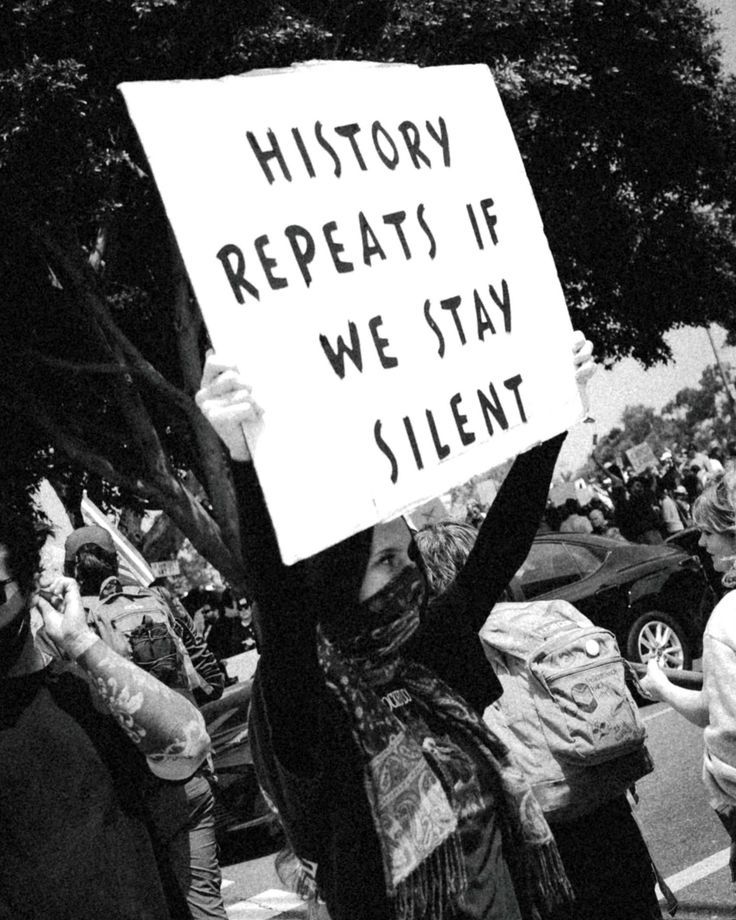
History Repeats If We Stay Silent Jan. 10, 2026
The world is watching events unfold that should stop us in our tracks. Not because history hasn’t shown us this before, but because it has.
There is suffering that cannot be spun. Loss that cannot be justified. And yet, we are witnessing leadership that responds not with compassion or clarity, but with detachment, confusion, and a startling absence of moral gravity. When empathy is replaced by ego, and complexity is met with slogans instead of thought, the consequences are never abstract. They are human.
Leadership matters most in moments like these. A leader does not need to be perfect, but they must be present. They must be capable of understanding the weight of their words, the impact of their silence, and the responsibility of their power. When those qualities are missing, the vacuum is felt everywhere: in global instability, in rising fear, and in the quiet realization that no one at the top seems to be paying attention.
History has always warned us about this. Not about villains in caricature form, but about leaders who lacked empathy, depth, or the ability to grasp consequences beyond themselves. Leaders who spoke without understanding, acted without reflection, and governed without conscience. The damage they caused wasn’t always immediate, but it was always lasting.
And when leadership fails, silence becomes dangerous. This is why voices outside of government matter so deeply right now. Writers, artists, comedians, actors, people whose roles were never meant to be political, are stepping forward not because they want power, but because they recognize responsibility. When someone like Jimmy Kimmel speaks, it isn’t a performance. It’s a human response. A parent’s response. A citizen’s response. A refusal to normalize indifference.
Their words resonate because they say what many are thinking but are afraid to articulate: This is not normal. This is not leadership. This is not acceptable.
We are often told that speaking out is divisive. But history shows us something different. Silence is what divides, between those who suffer and those who look away, between truth and comfort, between memory and denial.
Empathy is not weakness. Intelligence is not optional.
And leadership without either is not leadership at all.
One day, this period will be dissected. Analysts will debate decisions, language, and outcomes. But ordinary people, our children, our grandchildren, will ask a simpler question:
Did anyone speak when it mattered? History does not repeat itself because people didn’t know.
It repeats because too many decided it wasn’t their place to say anything.
This time, it is.
It is our place to notice when empathy disappears from the highest offices.
It is our place to question leadership that feels hollow, reactive, or disconnected from human consequence.
It is our place to say that intelligence matters, that compassion is not optional, and that indifference from those in power is not something we should ever learn to accept.
We are not asking for perfection. We are asking for humanity. When leaders speak without understanding, when they respond to devastation with platitudes or silence, they set a tone that filters downward. A tone that tells people their suffering is negotiable. That loss is a statistic. That outrage will pass if it is ignored long enough.
History shows us where that road leads. And so, the responsibility shifts, to citizens, to artists, to writers, to everyday people who refuse to normalize what should never be normal. Speaking out does not require authority. It requires conscience. It requires the courage to say, This isn’t leadership. This isn’t care. This isn’t right.
There will always be those who argue that silence is safer. That speaking invites backlash. That staying quiet preserves peace. But peace built on denial has never lasted. And safety purchased with silence has always come at someone else’s expense.
The world does not need louder voices.
It needs braver ones.
Voices willing to name absence where empathy should be.
Voices willing to question power when it loses its moral compass.
Voices willing to remember that history is not something behind us, it is something we are actively shaping.
One day, when this chapter is read back, the measure will not be how carefully people avoided offense. It will be how clearly they stood for humanity.
This time, it is our place.
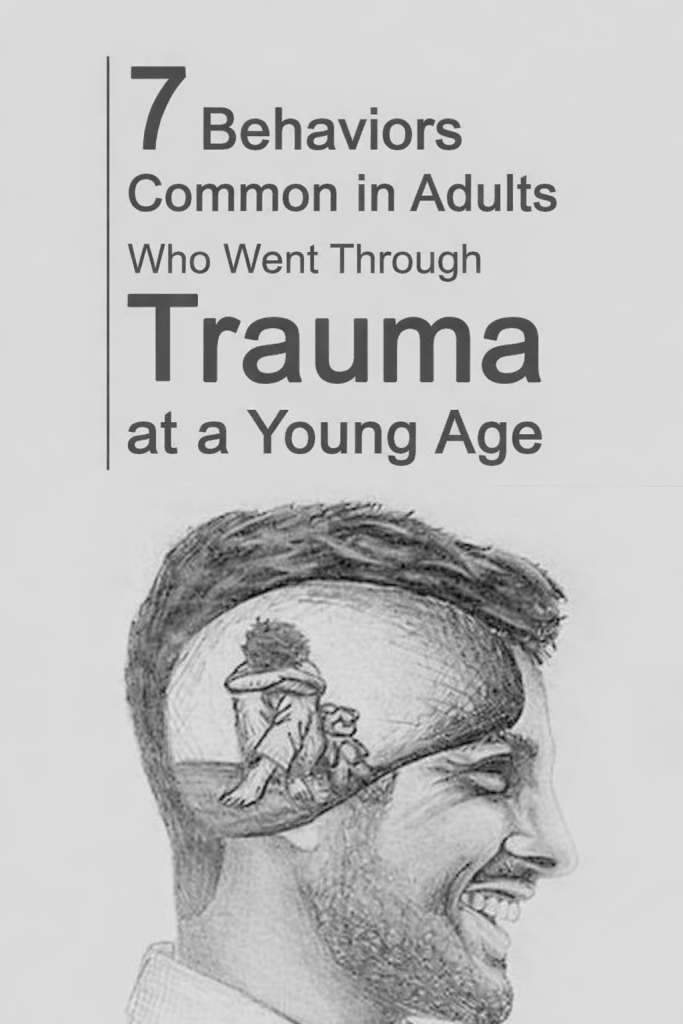
DO YOU RECOGNIZE THESE 7 BEHAVIORS? Jan. 3, 2026
For many adults, trauma isn’t something they think about often, not because it didn’t matter, but because it happened so early that it blended into normal. When experiences occur at a young age, we don’t label them as trauma. We adapt to them.
And those adaptations can quietly follow us into adulthood.
If you’ve ever wondered why you react the way you do, why certain patterns repeat, or why life can feel harder than it “should,” it may help to understand that many adult behaviors are rooted not in personality flaws, but in survival.
Here are seven behaviors commonly seen in adults who went through trauma at a young age, not as labels, but as invitations to self-understanding.
1. Hypervigilance
Always being on alert.
Reading tone, body language, and mood shifts instantly.
This often develops when a child learns that safety depends on anticipating what comes next. As adults, this can look like anxiety, difficulty relaxing, or feeling exhausted even when nothing is “wrong.”
2. Difficulty Trusting Others
Trust doesn’t come easily when it was broken early.
Adults with early trauma may keep emotional distance, test people without realizing it, or assume abandonment before it happens. This isn’t coldness, it’s protection.
3. People-Pleasing
Saying yes when you want to say no.
Putting others first at your own expense.
For many, this began as a way to keep peace or earn safety. Over time, it can lead to resentment, burnout, and losing touch with your own needs.
4. Strong Emotional Reactions
Big feelings that seem to come out of nowhere.
When emotions weren’t safe, welcomed, or regulated in childhood, the nervous system may struggle to self-soothe later in life. These reactions aren’t overreactions, they’re unresolved signals.
5. Need for Control
Control can feel like safety.
Adults who experienced chaos or unpredictability early on may feel uneasy with uncertainty. Planning, organizing, or controlling outcomes can become a way to feel grounded, until it becomes exhausting.
6. Emotional Numbness or Detachment
Not feeling much at all can also be a response.
Some people learned early that feeling was overwhelming or unsafe. Emotional shutdown isn’t absence of care, it’s a learned way to cope when feelings once felt like too much.
7. Difficulty Resting or Feeling at Peace
Stillness can feel uncomfortable.
When the body has lived in survival mode for a long time, calm can feel unfamiliar or even unsettling. Rest may bring guilt, anxiety, or restlessness instead of relief.
What Can Actually Help
Recognizing these behaviors is important — but awareness alone isn’t always enough. If these patterns are affecting your relationships, your health, or your ability to feel at ease in daily life, support can make a meaningful difference.
Here are clinically supported approaches that many adults with early trauma find helpful.
1. Trauma-Informed Therapy
Working with a therapist trained in trauma can help you understand how your nervous system learned to respond and how to gently retrain it. Modalities often used include:
- Trauma-focused cognitive behavioral therapy (TF-CBT)
- EMDR (Eye Movement Desensitization and Reprocessing)
- Somatic or body-based therapies
- Internal Family Systems (IFS)
These approaches focus not just on talking, but on helping the body feel safer over time.
2. Nervous System Regulation
Many trauma responses live in the body, not just the mind. Simple practices can help signal safety:
- Slow, paced breathing
- Grounding exercises (noticing what you can see, hear, feel)
- Gentle movement like walking or stretching
- Consistent sleep and meal routines
These aren’t “fixes,” but they help reduce chronic stress signals that keep the body on high alert.
3. Learning Emotional Skills
If emotions were overwhelming or unsupported early in life, learning skills later on can be transformative. This may include:
- Identifying and naming emotions
- Learning to self-soothe without self-judgment
- Practicing boundaries without guilt
These are skills, not traits you were born without.
4. Medical Support When Needed
For some people, trauma-related anxiety, depression, or sleep issues may benefit from medical evaluation. A healthcare provider can help determine whether medication or other treatments might be appropriate, especially when symptoms are interfering with daily functioning.
Seeking medical support is not a failure, it’s one part of comprehensive care.
5. Safe Relationships
Healing doesn’t happen in isolation. Safe, consistent relationships, whether with a therapist, friend, or support group, help the nervous system learn that connection doesn’t have to be dangerous.
You don’t need many people. You need safe ones.
A Gentle Reminder
None of these behaviors mean you are damaged or beyond help. They mean your system adapted early, and adaptation can be updated.
If reading this brought up recognition, discomfort, or relief, that’s information, not something to push away. You are allowed to seek help, ask questions, and move at your own pace.
Support isn’t about fixing who you are.
It’s about helping you feel safer being who you already are.
With love
©️Suzy Bourget
suzybourgetauthor.ca

WHAT IF THE NEW YEAR ISN’T ABOUT BECOMING SOMEONE NEW? Dec. 27th 2025
Every January, we’re told it’s time to reinvent ourselves.
New habits. New bodies. New goals. New lives.
Apparently, by February we’re all supposed to be waking up at 5 a.m., drinking green juice, journaling, stretching, manifesting abundance, and running marathons, all while smiling.
Meanwhile, some of us are just trying to remember what day it is.
I used to believe January was a starting line, that if I didn’t burst into the new year motivated and organized, I was already behind. That growth had to be loud. Visible. Measurable. Preferably color-coded.
But the older I get, the more I realize something important:
Not every new year is about becoming someone new.
Some years are about staying.
Staying with what you’ve already learned.
Staying with the healing you’ve already worked so hard for.
Staying kind to the parts of you that are still tired, and maybe a little over everyone’s expectations.
Life doesn’t magically reset because the calendar flips. The grief you carried, the exhaustion you earned honestly, the lessons that came at a cost, they don’t vanish at midnight on December 31st. And frankly, they shouldn’t have to.
We’re allowed to enter a new year carrying what matters and leaving behind what never fit us in the first place. (Including resolutions, we’ve already broken by January 3rd. Let’s be real.)
What if growth doesn’t mean changing who you are, but honoring who you’ve become?
What if this year isn’t asking you to push harder, hustle louder, or “do more” but to listen more closely?
January sits in the middle of winter for a reason. Nature isn’t rushing. Nothing is blooming yet. Even the trees are like, absolutely not. Things are resting underground, gathering strength in quiet, unseen ways.
Maybe we’re allowed to do the same.
If you’re starting this year feeling tired instead of inspired…
If your heart wants steadiness more than ambition…
If you don’t have a word of the year, a five-year plan, or the energy to pretend you do…
You’re not failing the new year.
You’re just being honest.
Maybe this year isn’t about becoming someone new.
Maybe it’s about trusting that who you already are, messy, healing, imperfect, still learning, is enough to keep going.
And maybe beginning gently isn’t lazy or unmotivated.
Maybe it’s wise.
With love
©️Suzy Bourget
suzybourgetauthor.ca

WE ALL STAND UNDER THE SAME MOON Dec. 20, 2025
There is something humbling about this image.
Santa, a symbol we’ve wrapped in tradition, religion, commerce, nostalgia, sitting quietly before the moon. Not delivering. Not rushing. Not judging. Just being.
And the moon looms behind him, enormous and steady, reminding us of something we so easily forget:
No matter who we are.
No matter where we come from.
No matter what name we give to God, spirit, universe, or love
we all stand under the same sky.
The moon doesn’t ask who deserves its light.
It doesn’t care about borders, beliefs, politics, wealth, or status.
It shines on the grieving and the joyful.
On the faithful and the questioning.
On the lonely and the loved.
Equally.
Somewhere along the way, we turned difference into division. We started measuring worth instead of recognizing humanity. We forgot that before labels, before systems, before power, we were simply people trying to survive, to belong, to be seen.
This season, whatever you celebrate or don’t celebrate, is not meant to separate us. It’s meant to soften us.
To remind us that kindness is not a belief system.
Compassion is not a political stance.
And love is not reserved for those who think like us.
I believe this is a time to pause. To sit, like the figure in this image, and remember that none of us are above another. None of us are beneath another. We are equal not because we are the same, but because we are human.
If we could remember that, even briefly, the world would feel different.
Maybe healing doesn’t come from louder voices,
but from quieter moments of shared humanity.
From remembering that under the same moon,
we all belong.
With love ©Suzy Bourget

WHEN WINTER REMINDS US TO SLOW DOWN Dec. 13, 2025
I don’t usually stop and stare at artwork for long, but this one made me.
There’s something about it, not magical or mythical, just steady.
A quiet, older presence looking out over a winter world that isn’t rushing, scrolling, posting or panicking. Just existing.
When I look at his face, he doesn’t feel like Santa or a legend.
He feels like every wise grandfather we’ve ever known:
someone who has lived enough life to say nothing, yet hold everything.
Winter has a way of doing that too.
In a time when the world feels louder than ever,
constant updates, constant opinions, constant pressure to be on,
this picture feels like the opposite:
a reminder of stillness, of breathing, of pausing without guilt.
There was a time when winter meant slowing down because we had to.
Shorter days, earlier nights, quieter homes.
People talked to each other because the weather insisted on it.
Stories were shared, meals were stretched, and evenings were simple.
Now, even in a snowstorm, our minds keep racing.
We worry about the next message, the next bill, the next change, the next crisis.
We fill the quiet because we’ve forgotten how to sit in it.
Looking at this image, I realize how much we need what winter used to give us:
not the cold, not the darkness,
but permission.
Permission to say:
“I don’t have to do everything today.”
“I can rest.”
“I can log off.”
“I can just be.”
The old winter figure in the clouds feels like a silent witness to how different life has become.
Not judging, not lecturing, just… watching.
Maybe even waiting for us to remember the pace we once lived by.
A pace where people mattered more than productivity,
where a quiet evening wasn’t seen as wasted time,
and where warmth was measured in connection, not electricity.
Maybe that’s why I love this image.
It isn’t fantasy.
It’s a reflection, of winter, of age, of perspective, and of what we’ve lost while trying to keep up with a world that refuses to slow down.
So tonight, as snow gathers outside and the world finally settles,
I’ll think of him, steady, calm, unbothered,
and I’ll try to do the same.
With love,
© Suzy Bourget

“Bingo, Burgers, and a Boat Named Bob” Dec. 06, 2025
The sun had barely risen over the sleepy coastal town when the three beachside besties, Gloria, Mabel, and Dot, emerged from their cottage wearing matching flamingo-print robes, their hair already sky-high and sprayed into place like some sort of steel wool masterpiece. They had a mission that day. And it didn’t involve knitting, baking, or napping.
It started over morning coffee when Gloria slapped a hand on the table and declared, “Ladies, today… we hijack a boat.” Mabel nearly choked on her prune juice. “We don’t even know how to drive one!” Dot just grinned and tightened her sunhat. “Details, Mabel. That’s future-us’s problem.”
By 10 a.m., the three of them were strutting down to the marina like they owned the dock, armed with oversized sunglasses, tote bags full of snacks, and zero nautical experience. They came upon an old, slightly dented fishing boat named Bob. It looked like it had seen better decades, but it was unattended… and therefore, in their eyes, fair game.
Gloria climbed in first. “It’s got character,” she said proudly. “It’s got mildew,” Mabel mumbled. Dot climbed aboard and found a weathered captain’s hat. “Well, I guess I’m the captain now.”
With a surprising amount of luck, and help from a teenager who mistook them for an elderly YouTube prank channel, they got Bob going. They didn’t go far, just a scenic putter around the bay, where they sang oldies at the top of their lungs, grilled questionable cheeseburgers on a tiny camp stove, and waved at every passing kayak like queens on a float.
Of course, they ran out of gas two hours in. “No worries,” Dot shrugged, lying back with her sunhat over her face. “We float home.” “Or we make Bob our new retirement plan,” Gloria added. “We Airbnb him out. Luxury sea lodging with character.”
Mabel sighed. “Can we at least fish while we wait?” Dot reached into the snack bag and pulled out a loaf of bread. “This is now bait.”
Three hours later, the coast guard arrived to the sight of three grandmas sunbathing on a boat that was half-decorated with fishing lures, a “Help” flag made of a beach towel, and an inflatable flamingo they named Sir Francis Float.
As they were towed back in, Gloria whispered, “Let’s do bingo tomorrow.” Mabel grinned. “Only if it ends with us in jail.”
Dot raised her sparkling water in the air. “To chaos, ladies.” And they clinked their cans in pure, glorious, rebellious harmony.

TOO YOUNG TO CARE, TOO OLD TO PRETEND Nov. 29, 2025
So, a young man comes up to me the other day and asks, “Hey, what’s it feel like to be old?” I nearly spat out my prune juice from surprise because, frankly, I don’t think of myself as old. The kid looked mortified when he saw my reaction, but I assured him it was an intriguing question. After pondering it, I came to the brilliant conclusion that getting old is a total gift.
Sure, sometimes I catch a glimpse of the old girl staring back at me in the mirror, but hey, I don’t lose sleep over it. I’m not about to swap all the wisdom I’ve gathered for a few less silver hairs and a washboard stomach. I’m entitled to a bit of messiness, some extravagance, and a few hours admiring my garden without feeling guilty.
I’ve seen friends leave this world before they could enjoy the freedom that comes with aging. So what if I choose to stay up till 4 a.m. reading or gaming, and then snooze until who-knows-when? I’ll groove to the tunes of the ’50s and ’60s, and if I fancy shedding a tear for a lost love later on, you bet I will!
I’ll strut along the beach in a swimsuit hugging my old bod and dive into the waves without a care, despite the pitying glances from the bikini brigade. They’ll get their turn at growing old if they’re lucky.
Sure, my heart’s endured its share of pain, losing loved ones, feeling a child’s agony, or bidding farewell to a furry friend. But it’s those trials that toughen us up and help us grow. A heart that’s never been bruised is about as lively as a rock and will never savor the joy of imperfection.
I take pride in every silver strand on my head and in retaining the grin of my youth before those deep wrinkles showed up. So, to give an honest answer to the question: “I love being old because it makes me sharper and more liberated!”
Hey, I know I won’t be around forever, but while I’m here, I’m living by my own rules, the ones my heart cooks up. No regrets for what never happened, no fretting over what’s to come. For the time ahead, I’m just going to revel in life like I always have. The rest? Well, that’s in the hands of the big guy upstairs.
©️Suzy Bourget

LETTING GO OF HURTFUL PEOPLE Nov. 22 2025
There comes a moment in life when your heart whispers something you’ve been trying to ignore. A moment when the truth gets louder than the excuses, and you realize that holding on to someone who hurts you doesn’t make you loyal, it makes you tired.
Letting go isn’t about giving up.
It isn’t about being cold or unkind.
And it definitely isn’t about winning or losing.
Letting go is simply this:
Choosing yourself.
For the longest time, I believed that if I just loved harder, understood deeper, or stayed quieter, things would get better. I thought maybe if I explained myself differently, softened my edges, or forgave one more time, the hurt would magically disappear.
But hurt doesn’t vanish when you pretend it’s not there.
It lingers.
It grows roots.
It takes pieces of you.
And one day you wake up and realize you’ve been shrinking yourself to make room for someone who never deserved that much space in your life.
The truth is, some people only love the version of you they can control, dismiss, or take advantage of. They love the you who bends. The you who apologizes first. The you who doesn’t complain. The you who keeps trying.
But the real you?
The strong you?
The “I deserve better” you?
They don’t know what to do with her, so they try to break her spirit before she fully stands.
Letting go of a hurtful person is painful, even when you know it’s the right thing to do. It feels like grieving someone who’s still alive. It feels like closing a door you kept open for years. It feels like losing a battle you never wanted to fight in the first place.
But here’s the truth no one tells you:
Letting go is an act of love,
not for them, but for yourself.
It’s the moment you finally say:
“I’m done accepting the bare minimum.
I’m done shrinking my light.
I’m done pretending this doesn’t hurt.”
The day you let go is the day you start healing.
You start remembering who you were before the damage.
You start rediscovering the parts of yourself you had to mute.
You start seeing your worth without waiting for someone else to confirm it.
And slowly, bit by bit, you breathe again.
Letting go doesn’t mean you stop caring.
It doesn’t mean the memories disappear.
It means you are choosing peace over chaos, healing over history, and your future over their comfort.
You deserve the kind of love that feels like home, not a battlefield.
And if letting go is the price of peace?
Then peace is worth every tear.
With love,
©Suzy Bourget
 Suzy Bourget Author and Blogger