
Welcome to my Blog

If you’ve made your way here, welcome. Pull up a chair, get comfortable, and stay awhile.
I’ve been blogging since 2014, sharing my thoughts on life, relationships, personal experiences, and whatever happens to catch my attention. Sometimes the subjects are serious, sometimes they’re funny, and occasionally, I have a thing or two to get off my chest.
I’m also a fiction author, with stories born from vivid dreams or unexpected ideas that pop into my head and refuse to leave. My imagination has a habit of taking me places I never planned to go.
Over the years, this blog has become a collection of memories, opinions, lessons learned, and reflections on the world around me. I don’t have all the answers, but after all these years, I certainly have a few stories to tell.
Whether you’ve been following along for years or you’re just discovering my writing, I’m glad you’re here.
Enjoy your visit? Follow me on Facebook for my latest blog posts, book news, a little humour, and whatever else happens to be on my mind!
Follow Suzy Bourget on Facebook

Three Grannies and a Very Misleading Brochure
Another adventure with Gloria, Mabel, and Dot
After the incident with the boat named Bob, Mabel made Gloria promise their next outing would involve assigned seating and a qualified person in charge.
So when Gloria appeared at the breakfast table holding three theatre tickets, Mabel was delighted.
“Finally. A little culture.”
Dot glanced at the brochure. Then she glanced at Gloria.
Gloria gave her a small kick under the table.
“What sort of show?” Mabel asked, buttering her toast.
“Dancing,” Gloria said.
“Oh, lovely. I hope there’s tap.”
Dot lowered her face behind her coffee cup.
By seven that evening, Mabel was standing outside the cottage in a lavender blouse, pearls, and sensible shoes. She had packed peppermints, tissues, and a small pair of binoculars.
Gloria eyed the binoculars hanging around her neck.
“Are you expecting us to sit across the street?”
“I like to see the costumes.”
Dot had to go back inside for a minute.
Apparently, she’d forgotten something. Judging by the sounds coming through the screen door, it was her ability to breathe.
The venue was considerably louder than Mabel expected. There were pink feather boas at the entrance, cocktails named things she refused to say aloud, and a woman near the front wearing a sash that read STILL GOT IT.
Mabel studied her.
“Got what?”
“Let’s find our seats,” Gloria said.
Their table was directly beside the stage.
Mabel looked pleased. “Well, we certainly won’t need these.” She tucked the binoculars into her handbag.
A waitress arrived.
“What can I get you ladies?”
“White wine,” Gloria said.
“Same,” said Dot.
“Tea, please,” Mabel said. “In a proper cup, if you have one.”
The waitress hesitated, then nodded.
As she walked away, Mabel leaned towards her friends.
“She looked surprised. You’d think nobody had ever ordered tea before.”
The lights dimmed.
A voice boomed through the speakers.
“LADIES! ARE YOU READY?”
Mabel sat up straight.
“What a friendly introduction.”
Five men appeared onstage in firefighter uniforms.
“Oh!” she said. “Is this a fundraiser?”
Gloria reached for her wine.
The music started. The men danced. Mabel nodded along approvingly until the one in the middle grabbed his shirt and pulled it open.
She stopped nodding.
A second shirt came off.
Then a third.
Mabel slowly turned towards Gloria.
“Is the building very warm?”
Dot made a small choking noise.
By the time the trousers came off, Mabel had both hands flat on the table.
“Gloria.”
“Yes?”
“You said theatre.”
“It has a stage.”
One of the dancers approached their table wearing boots, a helmet, and very little else.
Mabel looked him directly in the face with the determined concentration of a woman avoiding several other things.
“Good evening,” he said.
“Hello,” she replied. “Are your parents aware you do this?”
He laughed.
Dot folded over her knees.
The dancer held out his hand to Mabel.
She stared at it.
“Oh, no. Thank you. I’ve only just had my knees done.”
He moved towards Gloria, who was already pushing back her chair.
“Mine are fine.”
“Since when?” Dot asked.
Gloria ignored her.
Within seconds, she was onstage sitting in a chair while two dancers circled her. She waved at her friends with the serene confidence of someone accepting an award.
Mabel grabbed Dot’s wrist.
“Should we help her?”
Dot watched Gloria adjust a young man’s collar.
“I don’t think she wants help.”
The waitress returned with the tea.
Mabel took one look at Gloria, who was now holding a firefighter’s helmet above her head.
“Actually,” she told the waitress, “could you bring me what they’re having?”
“White wine?”
“Yes. And leave the tea. I may need both.”
Halfway through the next routine, a dancer flung his shirt into the audience.
Mabel caught it.
Nobody was more surprised than Mabel.
The woman at the next table reached towards it, but Mabel pulled it into her lap.
“He threw it to me.”
Dot stared at her.
“I thought you disapproved.”
“I do. But I’m not giving her my shirt.”
When Gloria returned, flushed and missing one earring, Mabel was examining the label.
“Cold wash,” she announced. “Well, that explains why it’s so tight.”
Gloria sat down and fanned herself with the drinks menu.
“I think his name was Antonio.”
“Which one?” Dot asked.
“The helpful one.”
“They were all helping you, Gloria. At one point, you had a committee.”
Mabel quietly took the binoculars out of her bag.
Dot noticed.
“Thought we didn’t need those?”
“I’m looking for Gloria’s earring.”
“Of course you are.”
By the end of the evening, Gloria had a signed poster, Dot had photographic evidence, and Mabel had agreed to return the shirt personally.
Its owner thanked her and asked whether she’d enjoyed the show.
“It was very well rehearsed,” she said.
Outside, the cool night air did little for Gloria, who was still fanning herself.
“Well?” she asked. “Better than bingo?”
Mabel straightened her pearls.
“You could have told me.”
“You wouldn’t have come.”
“No,” Mabel admitted. “I wouldn’t.”
They walked a few more steps before she added, “And those tickets weren’t cheap. Next time, we should ask about a group discount.”
Dot stopped.
“Next time?”
Mabel opened her handbag to put away the binoculars.
A firefighter’s glove fell onto the pavement.
Gloria looked down at it.
Mabel picked it up.
“Oh, for heaven’s sake,” she said. “Now we have to go back.”
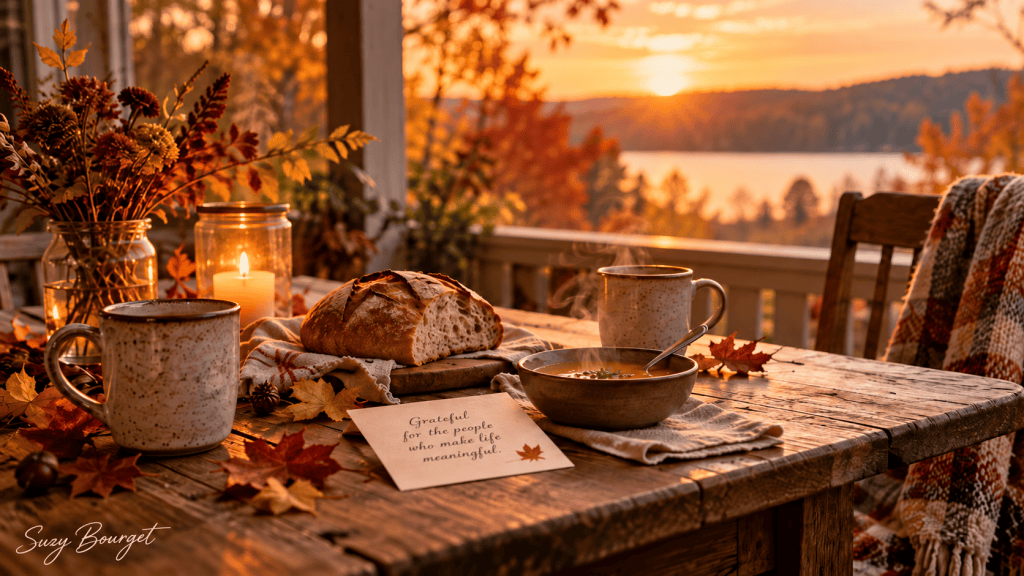
THANKSGIVING ISN’T ABOUT WHAT’S ON THE TABLE
Thanksgiving has always been a time when we think about family, friends, good food, and the comfort of being surrounded by people we love. There’s something special about the smell of a turkey cooking, the sound of laughter coming from the kitchen, and everyone gathering around the table to share a meal.
But this year, I’ve been thinking about Thanksgiving a little differently.
We live in a world where putting a meal on the table isn’t as easy as it once was. Groceries have become so expensive that what used to be an ordinary family dinner can now feel like a luxury. For some families, buying a turkey and all the trimmings means sacrificing something else they need. Others are simply doing their best to get through another week.
And I think we need to talk about that.
Because while social media fills up with pictures of beautiful Thanksgiving dinners, perfectly decorated tables, and happy families gathered together, there’s another side to this holiday that we don’t always see.
Some people will spend Thanksgiving alone. Others will be missing someone who once had a special place at their table. There are families separated by distance, relationships that have changed, and people who would give anything just to hear a familiar voice one more time.
Then there are those who won’t have a special dinner at all. Not because they don’t want one, but because they simply can’t afford it.
I wonder sometimes if we’ve become so caught up in what a holiday is supposed to look like that we’ve forgotten what it’s really meant to feel like.
For me, Thanksgiving has never been about how much food is on the table or how many people are sitting around it.
It’s about connection.
It’s knowing that somewhere, someone is thinking about you. It’s a phone call from a family member who lives miles away. A message from an old friend. A neighbor checking in. It’s sharing a laugh, remembering the good times, and finding comfort in knowing we’re still part of each other’s lives, even when we can’t be together.
Sometimes the most meaningful part of Thanksgiving has nothing to do with dinner.
It might be sitting quietly with a cup of coffee, remembering the people who’ve made a difference in your life. It could be reaching out to someone you haven’t spoken to in a while or letting somebody know they’re missed.
And maybe, if we’re fortunate enough to have a little extra, it’s remembering those who don’t.
That doesn’t have to mean doing something grand. An invitation to dinner, a plate of leftovers, a small bag of groceries, or simply taking the time to make someone feel included can mean more than we realize.
I also believe we need to be careful about telling everyone to count their blessings. It’s a lovely sentiment, and one I’ve used myself, but life isn’t equally kind to everyone.
Someone struggling to pay their bills doesn’t need to be reminded how fortunate they are. A person grieving a loved one might not feel particularly thankful right now. And someone facing loneliness, illness, or uncertainty may be doing everything they can just to get through the day.
They deserve kindness, not expectations.
I still love everything about a traditional Thanksgiving. The food, the warmth, the laughter, and yes, even that wonderful feeling of being so full you swear you’ll never eat another bite, only to find yourself looking for a piece of pumpkin pie an hour later.
But I don’t want to forget the people whose Thanksgiving looks nothing like that.
Because gratitude, to me, isn’t about pretending everything is wonderful. It’s about appreciating the love and kindness that still exist, even when life is difficult.
This Thanksgiving, whether you’re surrounded by family, sharing a quiet meal with one special person, or spending the day on your own, I hope you feel connected to someone who cares about you.
And if your table isn’t full this year, please don’t measure your life by what you can afford to put on it.
A simple meal shared with love can be just as meaningful as a feast.
So here’s my Thanksgiving wish.
May those who have plenty remember those who have little. May those who are lonely feel remembered. May families separated by distance find ways to stay close, and may those carrying sadness find a little peace.
Most of all, I hope we remember that Thanksgiving isn’t about creating the perfect holiday.
It’s about remembering one another.
Because at the end of the day, what matters most isn’t how full our tables are, but how much room we make in our hearts for each other.
Happy Thanksgiving to my family, my friends, my readers, and everyone who happens to find their way to these words. Wherever you are in life right now, I’m sending a little love your way. ❤️🍁
With love,
©️Suzy Bourget
suzybourgetauthor.ca
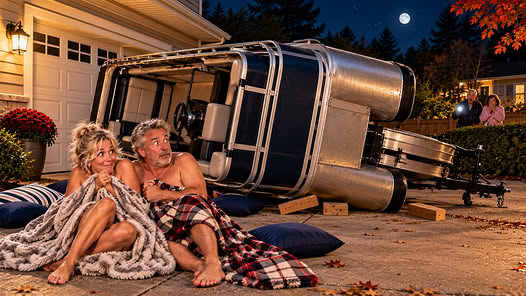
What Happens on the Pontoon… Doesn’t Always Stay on the Pontoon
Okay, I’m probably going to regret telling this story, but it’s one of those things that still makes me laugh every time I think about it.
It was fall, which around here means the boats start coming out of the water. Our pontoon was parked in the driveway on the trailer, with a couple of pieces of wood under the wheels.
And one night, we decided to make use of it.
Not for boating.
Not for sitting around having a drink.
We had something else in mind.
We figured it was dark, nobody was around, and the neighbours probably couldn’t see us.
So we grabbed a couple of blankets and pillows and quietly headed out to the pontoon for a little “cozy time.” 
We were already giggling before we even got settled.
“Shhhh…”
“Why are you laughing?”
“Because you’re laughing!”
“I’m trying to be quiet!”
That, of course, made us laugh even more.
We were having a good time and trying our best to keep the noise down because, well… the last thing we needed was the neighbours hearing us.
Everything was fine.
Until the pontoon started rocking.
At first, we didn’t pay much attention to it.
Then it rocked a little harder.
We stopped.
Looked at each other.
And then it happened.
CRASH!
The pontoon came right off the blocks and tipped over onto its side.
Suddenly our little private evening wasn’t so private anymore.
We were scrambling around in the dark, trying to figure out what had happened and, at the same time, trying to get our clothes back on.
And then…
the neighbours came outside.
Of course they did.
They had heard the crash and wanted to see what was going on.
There we were, in the middle of the driveway, with the pontoon lying on its side and the two of us trying to look like this was a perfectly normal thing to be doing on a fall evening.
I’m pretty sure there wasn’t a whole lot of explaining that could make that situation look innocent.
And honestly, I have no idea what the neighbours thought.
But I’m guessing when they heard the giggling, then the rocking, followed by a huge crash…
they probably put two and two together.

Looking back, I have to admit it was pretty funny.
Although I’m not sure I’d recommend using a pontoon that’s sitting on blocks as your romantic getaway.
Because apparently, there’s a very fine line between “cozy” and “OH SHIT!”
And if you’re wondering who these two people were…
Well…
Let’s just say I know the story because I was there.

If Your House Could Talk, What Would It Say About You?
Mine would probably start with, “She came into this room for something. We may never know what.”
Then it would mention the number of times I’ve opened the fridge, stared inside, and closed it without taking anything. I’m sure the fridge has questions too.
But I think my house would be kind to me. It’s seen the days when I’ve laughed at my own jokes and the days when I’ve needed a quiet place to fall apart. It’s heard ideas for stories spoken out loud, followed by, “Wait, that’s actually good.”
Maybe that’s what a home really knows about us. All the little versions of ourselves that nobody else sees.
Although if my house could talk, I’d appreciate it keeping a few things to itself. Especially how often I lose my phone while I’m holding it.
What would your home say about you?

FALL, YOU BEAUTIFUL SHOW-OFF
I love fall.
There. I said it.
Summer is wonderful, but by September I’m usually ready to stop pretending I enjoy being hot all the time. There are only so many days a woman can sit outside sweating and call it “beautiful weather.”
Then fall arrives.
The mornings get cooler. The air smells different. The trees start showing off in red, orange and gold, and here in Northern Ontario, it can be absolutely breathtaking. Sometimes I’ll be driving somewhere I’ve driven a hundred times and suddenly think, Was that tree always that beautiful?
That’s what I love about fall. It makes me notice things again.
I love opening the door in the morning and feeling that cool air hit my face. I love putting on a sweater, making a hot coffee and not needing the air conditioner for once. I love the sound of leaves under my feet, even though I’m considerably less fond of them when they’re covering the yard and expecting me to do something about it.
Funny how a leaf can be gorgeous on a tree and downright annoying the minute it lands on your lawn.
Fall also makes me a little sentimental.
Maybe it’s because you can actually see things changing. One week everything is green, and before you know it, the whole landscape looks completely different.
It reminds me how quickly life moves.
We’re always waiting for something. The weekend. Summer. Christmas. A vacation. Better days. And sometimes we rush right through the season we’re actually standing in.
I’m trying not to do that anymore.
This fall, I want to notice the colours. Sit outside with my coffee a little longer. Take the drive just because the trees are beautiful. Enjoy the cool evenings before “cool” turns into “why do I live where the air hurts my face?”
Because we all know what comes after fall in Canada.
And winter is probably already standing around the corner tapping its watch.
So for now, I’m going to enjoy every colourful, crunchy, sweater-wearing minute of it.
Fall doesn’t stay long.
Maybe that’s exactly why it feels so special.
With love
©️Suzy Bourget
suzybourgetauthor.ca

WHEN BACK TO SCHOOL DOESN’T FEEL EXCITING
Back-to-school season is usually shown as something exciting.
New backpacks. Fresh notebooks. First-day photos. Kids heading out the door with nervous smiles.
But not every child is excited.
For some, September brings stomachaches, sleepless nights, irritability, tears, or a sudden refusal to go to school.
And anxiety doesn’t always look like fear.
Sometimes it looks like anger.
Sometimes it sounds like, “I don’t care.”
Sometimes it’s a child who comes home exhausted because they spent the entire day trying to look okay.
That’s what we sometimes miss.
School asks a lot of kids. New teachers. New classrooms. Homework. Social pressure. Friendships. Expectations. And underneath all of that can be one very simple worry:
Where do I fit in?
Of course, some nervousness is normal. Kids don’t need us to remove every uncomfortable feeling.
But they do need us to listen.
Instead of saying, “There’s nothing to worry about,” maybe ask:
“What part are you worried about?”
That one question can open a door.
It tells a child that their feelings matter and that they don’t have to handle everything alone.
As another school year begins, we’ll hear plenty about grades, homework and achievement.
Maybe we should also ask something simpler.
“How are you doing?”
Then give them enough time to answer honestly.
Because sometimes the child struggling the most isn’t the one crying in the hallway.
It’s the quiet one.
The straight-A student.
The athlete.
The class clown.
The one who has become very good at looking fine.
Back to school doesn’t feel exciting for everyone.
And sometimes the most important thing we can give a child isn’t advice.
It’s the feeling that someone is listening.
With love
©️Suzy Bourget
suzybourgetauthor.ca

UNITED, WE ARE TEAM CANADA
The trade talks between Canada and the United States have broken down, leaving Canadian workers, businesses and families wondering what comes next.
But this moment is bigger than politics.
It’s about protecting our country, our livelihoods and one another.
Canada isn’t a bargaining chip. We aren’t a punchline or a nation that should quietly accept whatever is placed before us.
We’re strong. We’re independent. And when it matters most, we stand together.
This isn’t about hating Americans. Ordinary Americans didn’t make these decisions. It’s about remembering who we are as Canadians.
Now is the time to support our farmers, workers, creators and local businesses. When we can, let’s choose Canadian, travel Canadian and stand behind the people who keep this country moving.
We may come from different provinces, cultures and political backgrounds. We may even disagree about what belongs on poutine.
But beneath those differences, we share the same home.
Canadian kindness has never been weakness. We can remain decent while standing our ground.
The talks may have broken down, but Canada doesn’t have to.
Not divided by politics.
Not separated by province.
Shoulder to shoulder.
Neighbour beside neighbour.
Heart beside heart.
United, we are Team Canada.
And we’re stronger together.
With love
Suzy Bourget
suzybourgetauthor.ca

I JUST WANTED GROCERIES, NOT A SECOND MORTGAGE
I went grocery shopping the other day with the completely unreasonable expectation that I might come home with food.
Apparently, I’m very ambitious.
There was a time when you could walk into a grocery store with a hundred bucks and leave looking like you were preparing for a six-month winter. Bags everywhere. Meat, vegetables, snacks, toilet paper, maybe even something completely irresponsible like a cake.
Now?
A hundred dollars gets you two bags and a receipt long enough to use as a scarf.
I walked into the produce section and picked up a package of berries. Looked at the price. Put them back.
I’m sorry, berries. I didn’t realize you’d gone private.
Then I wandered over to the meat department, where I discovered I apparently don’t have the financial qualifications to purchase steak anymore.
There should be a mortgage specialist standing beside the beef.
“Hi, Suzy. And how much were you hoping to borrow today?”
“Well, I was thinking two rib-eyes.”
“I see. And do you currently own your home?”
“Yes.”
“Excellent. We may be able to use that as collateral.”
At this point, I don’t even put meat in the cart right away. I stand there staring at it like I’m considering an investment property.
Is this chicken going to appreciate in value?
Maybe I should buy it and hold onto it.
“Don’t touch that, Rene. That’s for retirement.”
Then there’s cheese.
CHEESE.
When did cheese become something I should be leaving to my children in my will?
To my daughter, I leave my house.
To my grandchildren, my jewellery.
And to whoever loved me most, there’s an unopened block of old cheddar in the freezer.
Use it wisely.
And why does every grocery trip now involve making serious life decisions?
Do I need grapes?
Not at these prices.
Do I need cereal?
How badly?
Do I really need butter?
Apparently I’ll just rub the toast directly against the cow.
By the time I reach the checkout, I’ve already removed three items from the cart, substituted two others, and accepted that we’re having toast for dinner on Wednesday.
Then the machine has the nerve to ask:
WOULD YOU LIKE TO MAKE A DONATION TODAY?
Ma’am.
Read the room.
I’m standing here watching my bank account flatline because I bought eggs and laundry detergent.
I AM THE CHARITY.
Then comes the self-checkout.
Nothing makes paying an outrageous amount for groceries more enjoyable than being given a part-time job at the store.
“Unexpected item in bagging area.”
Yeah.
It’s my dignity.
“Please place item in bagging area.”
I DID.
“Please wait for assistance.”
Oh good. Maybe the assistance can also explain how six tomatoes, coffee and a package of toilet paper became a car payment.
Eventually I pay.
I take my three little bags home after spending what feels like the gross domestic product of a small nation, unload everything onto the kitchen counter and stare at it.
That’s it?
WHERE’S THE REST OF IT?
Surely there’s another bag in the car.
Nope.
I check the receipt again because perhaps I accidentally purchased a small yacht.
No yacht.
Just groceries.
And somehow the most insulting part is that three days later, somebody opens the refrigerator and says:
“There’s nothing to eat.”
Nothing to eat?!
I JUST REFINANCED THE HOUSE FOR THAT YOGURT.
Eat it.
Eat the container too.
We’re not wasting anything.
Maybe someday grocery shopping will become normal again. Maybe we’ll stroll through the aisles, casually tossing things into our carts without doing mental arithmetic every twelve seconds.
Until then, I’ll be in produce applying for financing.
I’ve got my eye on an avocado.
If everything goes well, it should be mine in 25 years.
With love
©️Suzy Bourget
suzybourgetauthor.ca

DON’T GIVE UP. THE BEGINNING IS ALWAYS THE HARDEST.
Starting something new always sounds exciting until it is time to actually begin.
That is when the doubts show up.
What if I fail?
What if I am not good enough?
What if everyone else knows exactly what they are doing and I am the only one making it up as I go?
I have felt this many times when beginning a new book. I sit at my computer with a fresh page in front of me, full of wonderful ideas. Then suddenly, I can’t remember how words work.
I type a sentence, delete it, stare at the screen, and decide it might be an excellent time to check Facebook.
But eventually, I return to the page.
That is what matters.
We sometimes believe we need confidence before we begin, but confidence usually comes after we have taken a few steps. At first, all we may have is a little hope and the willingness to try.
The beginning feels difficult because there is no proof yet that everything will work out. We are learning, stumbling, changing our minds, and figuring things out as we go.
That does not mean we are failing.
It means we are beginning.
Progress does not always look impressive. Sometimes it is writing one paragraph, taking one walk, making one phone call, or trying again after a disappointing day.
Small steps still count.
You do not have to begin perfectly. You only have to begin.
Give yourself permission to be new at something. Let the first attempt be messy. Let yourself pause when you need to, but do not let one difficult moment convince you to quit.
The beginning may be the hardest part, but it is also where every possibility starts.
With love
©️Suzy Bourget
suzybourgetauthor.ca

WHEN DID THAT HAPPEN?
There comes a time in every woman’s life when she looks in the mirror and thinks, Wait a minute… who authorized this?
One day everything is fine, and the next day a wrinkle has moved in like it owns the place. It didn’t ask permission. It didn’t sign a lease. It just showed up, unpacked, and brought friends.
And don’t even get me started on the lighting. Some mirrors are kind. Some mirrors are honest. And some mirrors need to be removed from the home immediately.
But here’s the truth.
Those lines are not proof that we are fading. They are proof that we have laughed, worried, loved, survived, raised eyebrows at nonsense, and kept going when life got messy.
Beauty changes, yes. But it does not disappear.
It deepens.
So here’s to every woman who has ever leaned into the mirror, squinted, and whispered, When did that happen?
You are still beautiful.
You are still strong.
You are still funny.
And honestly, at this stage of life, if we can’t laugh at the wrinkles, the chin hairs, and the mystery body noises… what are we even doing?
Here’s to growing older, bolder, and still cracking ourselves up along the way.
With love,
©️Suzy Bourget
suzybourgetauthor.ca
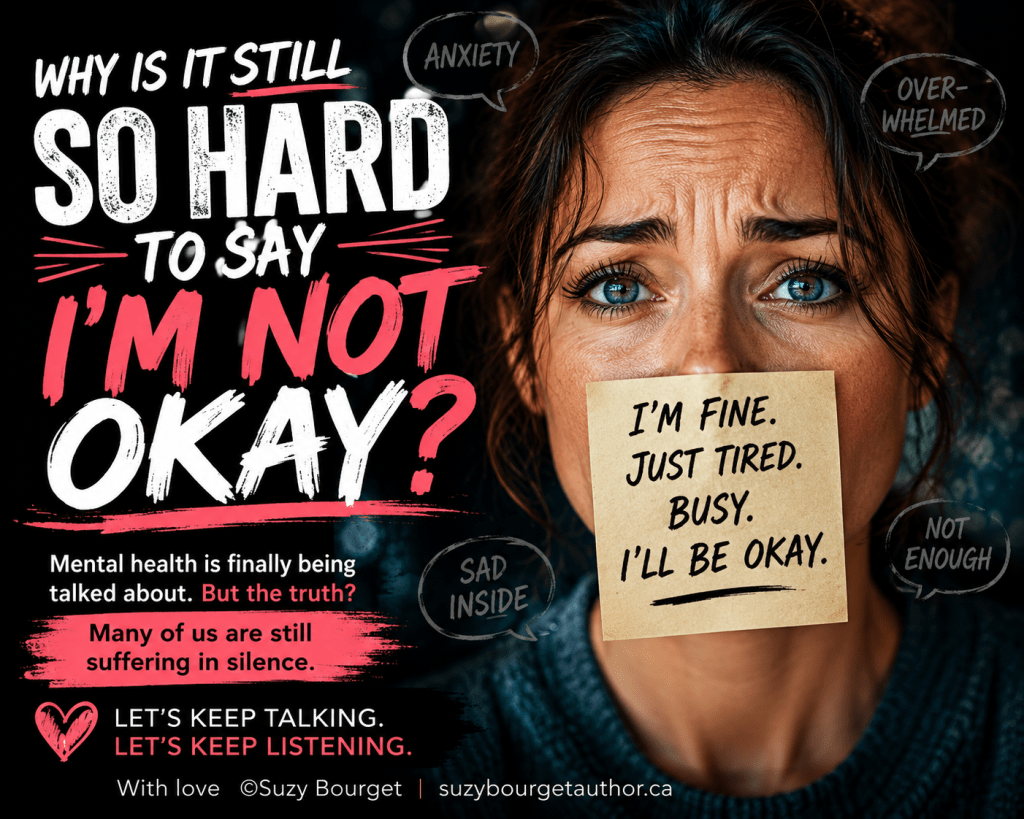
WHY IS IT STILL SO HARD TO SAY “I’M NOT OKAY”?
We live in a world where mental health is finally being talked about.
It’s on social media, in commercials, in workplace training, and in inspirational posts shared every day.
And yet, for so many people, the hardest words to say are still:
“I’m not okay.”
Isn’t that something?
We can encourage everyone else to speak up, reach out, and take care of themselves. But when it’s our turn, we suddenly become very good actors.
“I’m fine.”
“Just tired.”
“Busy, that’s all.”
“I’ll be okay.”
Meanwhile, inside, we may be overwhelmed, sad, anxious, exhausted, or simply carrying more than people realize.
I think one of the reasons we hide it is because we don’t want to be a burden. We don’t want to be “too much.” We don’t want people to look at us differently. And sometimes, we don’t even know how to explain what we’re feeling.
Because how do you explain that you’re tired in your bones?
How do you explain that nothing is technically wrong, but everything still feels heavy?
Mental health doesn’t always look the way people expect. Sometimes it looks like silence. Sometimes it looks like irritation. Sometimes it looks like cancelling plans, avoiding messages, or sitting in the car for five extra minutes before walking into the house.
And sometimes, it looks like a person who seems completely fine.
That is why kindness matters so much.
We never really know what someone is carrying behind their smile, their jokes, their Facebook posts, or their “I’m good, how are you?”
Some of us became very good at hiding because, at some point, we had to. Maybe we were told to toughen up. Maybe we opened up once and regretted it. Maybe we learned that being strong meant being silent.
But silence is not always strength.
Sometimes strength is saying, “I need help.”
Sometimes strength is saying, “I’m having a hard day.”
Sometimes strength is telling the truth to someone safe.
Not everyone deserves our deepest feelings, of course. We don’t need to unload our whole life story in the grocery store lineup because the cashier asked how we are.
Although, knowing me, one kind cashier could ask, “How’s your day going?” and suddenly I’m giving a full emotional TED Talk beside the bananas.
But somewhere, with someone safe, we need to be able to say what is real.
Because healing does not happen in pretending.
It happens when we stop trying to look okay long enough to actually become okay.
So if you are reading this and you have been pretending, I hope you know this:
You are not weak.
You are not broken.
You are not a burden.
You are human.
And being human is messy sometimes.
Maybe the next time someone safe asks how you are, you can try a softer truth.
“I’m having a hard day.”
“I’m overwhelmed.”
“I’m not okay right now, but I’m trying.”
That is not weakness.
That is courage.
Mental health should not just be something we post about when it is trending. It should be something we make room for in real life.
So let’s keep talking about mental health.
But more than that, let’s keep listening.
With love,
©️Suzy Bourget
suzybourgetauthor.ca
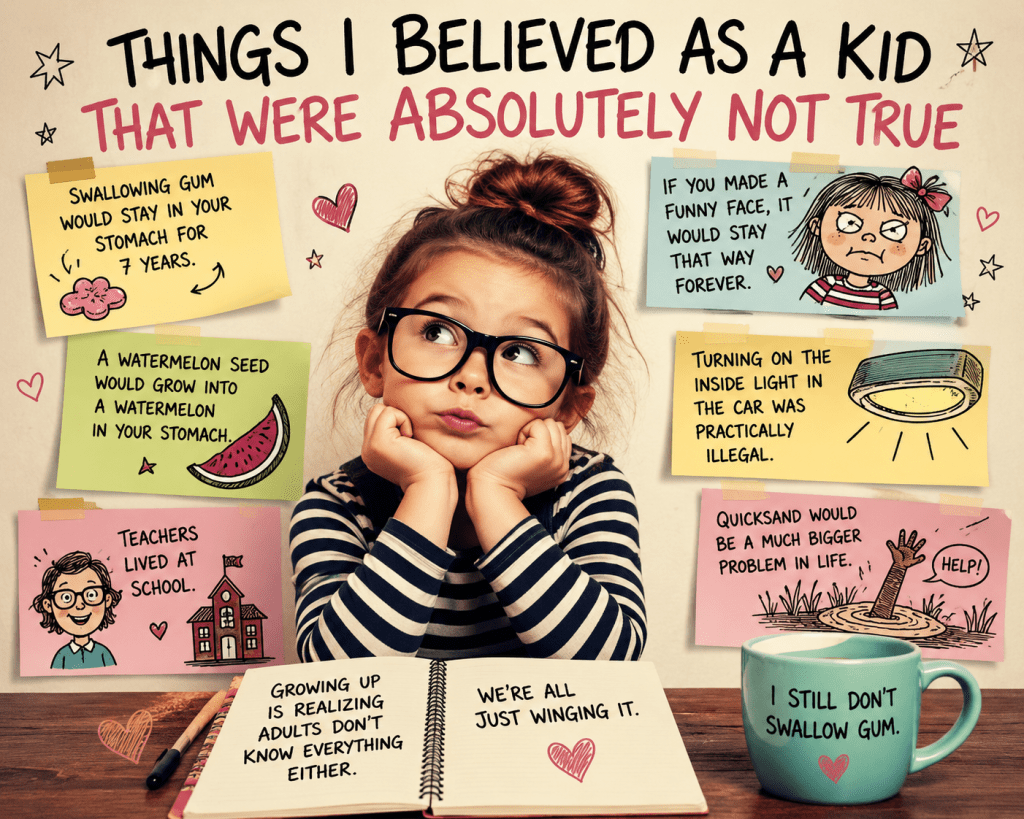
THINGS I BELIEVED AS A KID THAT WERE ABSOLUTELY NOT TRUE
When I was a kid, I believed a lot of things that turned out to be completely untrue.
I believed if I swallowed gum, it would stay in my stomach for seven years.
Seven years.
That is a long-term commitment for a piece of Juicy Fruit.
I believed if I swallowed a watermelon seed, a watermelon might grow inside me. I didn’t know how that would happen exactly, but I was not willing to take the risk.
I believed if I made a funny face, it could stay that way forever. Which, looking back, was a very effective way for adults to stop children from annoying each other in the back seat.
I believed teachers lived at school. Seeing one in the grocery store felt wrong, like spotting a giraffe at the bank.
I believed turning on the inside light in the car at night was practically illegal. The second that little light came on, someone would yell, “Turn that off! I can’t see!” and suddenly it felt like we were all in danger.
I also believed quicksand would be a much bigger problem in life.
Television made it seem like quicksand was everywhere. One wrong step and down you went, waiting for someone to throw you a vine. I’m happy to report I have made it this far without one quicksand incident.
Not one.
I believed adults knew everything.
That may have been the biggest misunderstanding of all.
As a child, adults seemed so sure of themselves. They drove cars, paid bills, made appointments, and always seemed to know where the scissors were. Then I became one and realized most of us are just doing our best while wondering why we walked into the room.
But maybe that’s what made childhood so sweet.
The world still felt mysterious. A seed could become a watermelon. A face could freeze. A teacher could live at school. A mother really could have eyes in the back of her head.
Growing up teaches us what isn’t true.
But I hope we never completely lose the part of us that believed a little magic was possible.
And for the record, I still don’t swallow gum without thinking about it.
With love
©️Suzy Bourget
suzybourgetauthor.ca
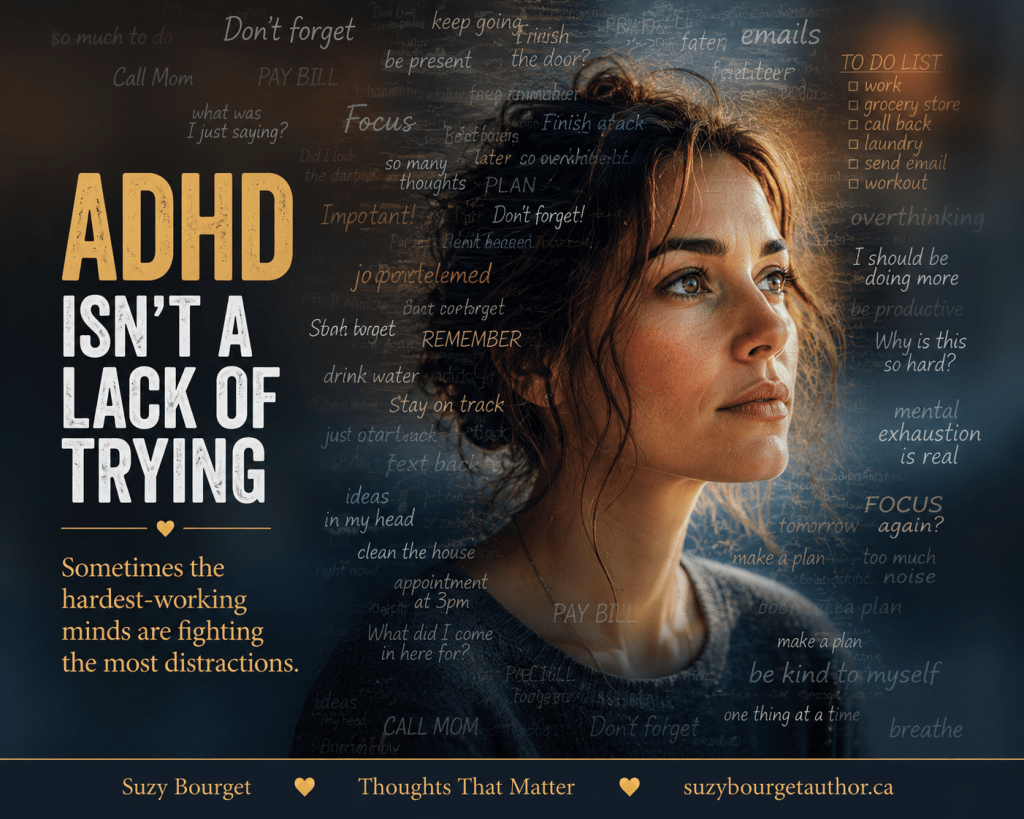
ADHD ISN’T A LACK OF TRYING
The other day, I was talking with someone about ADHD, and they said something I’ve heard many times before.
“They just need to focus.”
If only it were that simple.
For years, people with ADHD have been labeled as lazy, distracted, unmotivated, careless, or disorganized. They hear things like:
“Pay attention.”
“Try harder.”
“You just need more discipline.”
But here’s the truth: ADHD isn’t a character flaw. It’s a difference in how the brain works.
Imagine trying to watch one television show while fifty others are playing around you at the same time. Every sound grabs your attention. Every movement pulls your focus away. Every thought competes for space.
That’s what many people with ADHD experience every day.
The science backs this up. ADHD affects areas of the brain involved in attention, impulse control, and executive function, the skills that help us plan, organize, prioritize, and complete tasks. It’s not that people with ADHD don’t care. Often, they care deeply. Sometimes so deeply that the sheer number of thoughts and responsibilities becomes overwhelming.
What many people don’t see is the mental exhaustion.
They see the forgotten appointment but not the twenty reminders that didn’t stick.
They see the unfinished project but not the hours spent trying to get started.
They see the distraction but not the constant effort required just to stay on track.
And here’s something fascinating: people with ADHD can often focus intensely on things they love. It’s called hyperfocus. A person may struggle to pay attention to a ten-minute meeting but spend six straight hours absorbed in a hobby, a book, a game, or a creative project.
That isn’t inconsistency.
It’s how their brain is wired.
One of the greatest gifts we can give someone with ADHD isn’t advice.
It’s understanding.
Instead of saying, “Why can’t you just do it?” try asking, “How can I help?”
Instead of assuming they aren’t trying, assume they are fighting a battle you can’t see.
Because most people with ADHD have spent a lifetime feeling misunderstood.
A little patience can go a long way.
A little kindness can change someone’s day.
And a little understanding can help someone stop seeing themselves as broken and start recognizing that their brain simply works differently.
Not worse.
Just differently.
With love,
©️Suzy Bourget
suzybourgetauthor.ca ❤️
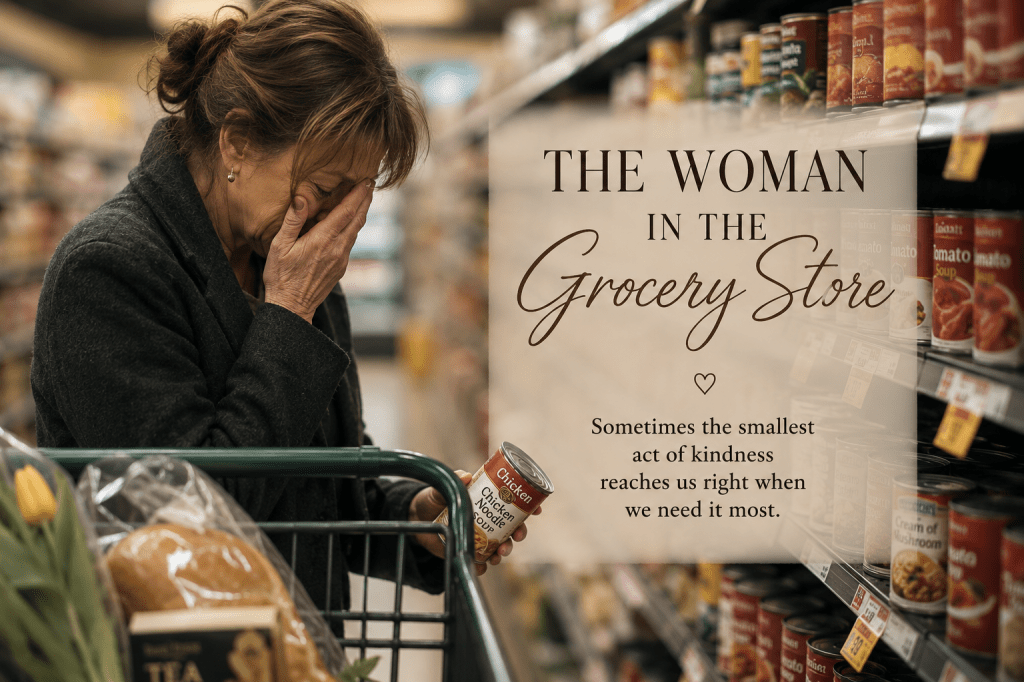
THE WOMAN IN THE GROCERY STORE
She didn’t cry when the doctor called.
She didn’t cry when she sat in the car with both hands wrapped around the steering wheel, staring through the windshield at a world that had somehow kept moving.
Cars still pulled in and out of the parking lot. People still pushed carts across the pavement. A young mother still bent down to tie her little boy’s shoe near the automatic doors. An older man still stood beside his truck, checking his receipt like the price of bananas was the most important thing happening on earth.
And maybe, for him, it was.
That was the strange thing about pain. When it arrived, it felt impossible that the rest of the world did not stop to notice.
But it didn’t.
The world kept turning.
The traffic lights changed. The carts rattled. Someone laughed too loudly near the entrance. The bakery doors slid open and released the warm smell of bread into the cold afternoon air.
And Ruth sat there, motionless, holding her phone in her lap.
The doctor’s words were still sitting inside her chest.
Not loudly.
Not dramatically.
Just sitting there, heavy and still.
She had nodded during the call even though the doctor could not see her. She had said, “Okay,” because people always seemed to say okay when things were very much not okay. She had thanked him, because politeness had a strange way of showing up even when your life was falling apart.
Then she had hung up and driven to the grocery store.
She didn’t know why.
Maybe because she had been on her way there when the phone rang.
Maybe because she needed something ordinary to do.
Maybe because buying bread and milk felt easier than going home and sitting alone with the news.
So she got out of the car.
She fixed her coat. She picked up her purse. She walked toward the doors like a woman who had not just been told that the world beneath her feet had shifted.
Inside, everything was too bright.
The lights hummed above her. The floor shone in clean, wide squares. The produce section looked almost cheerful with its towers of oranges, apples, peppers, and lettuce misted by little silver nozzles.
A child begged for grapes.
A man compared two bags of potatoes.
A teenage cashier laughed with another cashier near the front.
Ruth stood near the carts and tried to remember what she had come in for.
Bread.
Milk.
Tea.
Or was it soup?
She opened her purse and looked for the list she had written that morning. It was there, folded neatly beside a tissue and a lipstick she rarely used anymore.
Bread. Milk. Eggs. Tea. Soup. Bananas.
Six things.
A simple list.
A perfectly normal list for a perfectly normal woman on a perfectly normal afternoon.
Except nothing felt normal.
She took a cart because it gave her something to hold on to.
The metal handle was cold under her fingers, and for some reason that small detail almost undid her. Not the doctor’s voice. Not the results. Not the fear rising inside her like water behind a locked door.
The cold cart handle.
That was what nearly broke her.
She pushed forward.
The wheels wobbled slightly, one of them clicking every few feet.
Click.
Click.
Click.
She passed the flowers first.
Buckets of tulips, carnations, and roses sat wrapped in clear plastic near the entrance, their colours bright and hopeful. Yellow. Pink. Red. White.
Her husband, Robert, used to buy her grocery store flowers.
Not on special occasions. Not when he was in trouble. Just because.
He would walk in carrying a bouquet like he had discovered treasure.
“They were on sale,” he would say, as if that made the gesture less tender.
And Ruth would pretend to roll her eyes, but she would always put them in the blue vase by the kitchen window.
Robert had been gone for three years.
She thought grief had already taught her every trick it knew.
Apparently, it still had a few left.
She turned away from the flowers and headed toward the bakery.
Bread.
That was first on the list.
Bread was safe.
Bread did not require decisions about life or fear or what came next. Bread only required choosing between whole wheat and white, sliced or unsliced, fresh or on sale.
She stood in front of the shelves and stared.
There were too many choices.
Too many labels.
Too many promises printed on plastic bags.
Soft. Fresh. Ancient grain. No sugar added. Thick sliced. Thin sliced. Family size.
Family size.
Her hand stopped in midair.
Once, a family-size loaf made sense in her house. Robert made toast every morning, always too dark, always scraping the burnt edges into the sink. Their children used to run through the kitchen half-dressed, late for school, asking where their mittens were, where their permission slips were, where their lives were, apparently, because no one could ever find anything before eight in the morning.
Back then, bread disappeared quickly.
Now, half a loaf went stale before Ruth could finish it.
She picked up the smallest loaf she could find and placed it in the cart.
Click.
Click.
Click.
She moved to the dairy aisle.
Milk.
A woman stood nearby talking into her phone.
“No, I told him if he wants chicken, he can cook chicken,” the woman said, reaching for cream. “I’m not a restaurant.”
Ruth almost smiled.
Almost.
She chose a small carton of milk and put it beside the bread. Then eggs. Then tea.
She was doing well.
She was moving.
She was functioning.
People underestimated how much strength it took to function when your mind was full of fear. To choose eggs. To compare prices. To smile politely when someone reached past you for yogurt. To keep your face arranged in a way that did not alarm strangers.
By the time she reached the soup aisle, her hands were trembling.
Not enough for anyone to notice.
Just enough for her.
Soup had always been Robert’s answer to everything.
Cold? Soup.
Tired? Soup.
Upset stomach? Soup.
Snowstorm coming? Better get soup.
He had believed soup could solve far more than soup had any right to solve.
Ruth stood in front of the cans and stared at the labels.
Tomato.
Chicken noodle.
Vegetable.
Cream of mushroom.
Beef barley.
She could not choose.
It was ridiculous.
She knew it was ridiculous.
A grown woman should be able to choose soup.
But the doctor’s voice was there again, calm and careful, using words like follow-up and treatment and options. Words that sounded gentle until they landed in your life and rearranged the furniture.
Ruth reached for a can of tomato soup.
Her fingers missed.
The can tipped forward, hit another can, and then three of them rolled off the shelf and clattered onto the floor.
The sound was enormous.
At least, it felt enormous.
Several people turned.
Not rudely. Not cruelly. Just instinctively.
Ruth froze.
One can rolled toward the middle of the aisle and stopped near a pair of brown winter boots.
A woman about Ruth’s age bent down and picked it up.
She had silver hair tucked behind her ears and a face that looked kind before it even smiled. She held the can in one hand and looked at Ruth, not with pity, but with something softer.
“Tomato soup is dramatic today,” the woman said.
Ruth blinked.
The woman placed the can back on the shelf and bent to collect the others.
Ruth tried to speak, but her throat tightened.
“I’m sorry,” she managed.
“For what?” the woman asked. “The soup started it.”
It was such a small joke.
Not even a very funny one.
But it loosened something in Ruth’s chest.
She laughed once, quietly, and then her eyes filled so suddenly she had to look away.
The woman noticed.
Of course she did.
Some people notice the weather. Some people notice prices. Some people notice when another human being is barely holding herself together beside the canned goods.
The woman did not ask, “Are you okay?”
Ruth was grateful for that.
There were few questions more impossible to answer honestly in a grocery store.
Instead, the woman said, “Take your time, sweetheart. The world can wait a minute.”
And that was it.
That was the sentence.
The one small sentence that slipped past every wall Ruth had built since the phone call.
Take your time, sweetheart.
The world can wait a minute.
Ruth put one hand on the shelf.
“I got some news today,” she whispered.
The woman nodded slowly.
“I thought so.”
Ruth gave a small, embarrassed shake of her head. “I don’t even know you.”
“No,” the woman said gently. “But I know that look.”
For a moment, neither of them moved.
A man pushed his cart into the aisle, saw the two women standing there, and quietly backed out as if he had wandered into a church by mistake.
The kindness of that nearly made Ruth cry harder.
“I came in for bread,” Ruth said, wiping under one eye with the side of her finger. “Can you imagine? I got a phone call like that and came in for bread.”
The woman smiled sadly. “Sometimes bread is the only thing we know how to do next.”
Ruth looked at her.
There was something in that sentence too.
Something true.
Something earned.
The woman reached for a can of chicken noodle soup and placed it in Ruth’s cart.
“Get this one,” she said. “Tomato soup is too bossy when you’re already overwhelmed.”
Ruth let out another fragile laugh.
The woman added a second can.
“And one for tomorrow,” she said. “Tomorrow always acts like it isn’t coming, but it does.”
Ruth swallowed.
“What’s your name?” she asked.
“Ellen.”
“I’m Ruth.”
Ellen nodded, as if Ruth had handed her something important.
“Do you have someone to call when you get home, Ruth?”
Ruth looked down at her cart.
Bread. Milk. Eggs. Tea. Soup.
A life reduced to ordinary things.
“My daughter,” she said. “But I don’t want to scare her.”
Ellen’s face softened. “You won’t scare her by needing her.”
Ruth pressed her lips together.
That was another sentence she was not ready for.
Because mothers were supposed to be strong. Even adult mothers with adult children. Maybe especially them. Ruth had spent her whole life being the calm voice, the packed lunch, the remembered birthday, the extra blanket, the person who said, “Don’t worry, I’ll handle it.”
She did not know how to become the person who needed handling.
Ellen seemed to understand that too.
“My son once told me something,” Ellen said. “He said, ‘Mom, you don’t have to earn love by being easy to worry about.’”
Ruth looked at her then, really looked at her.
Ellen’s eyes were clear, but there was history in them. Not fresh pain, maybe, but old pain that had become part of her face in a gentle way.
“Did you believe him?” Ruth asked.
Ellen smiled.
“Eventually.”
They stood there a little longer.
Two women in the soup aisle.
Two carts.
Two lives.
All around them, the grocery store carried on. Someone asked where the crackers were. A child laughed from the next aisle. A cashier’s voice came over the speaker asking for a price check.
The world was still turning.
But it felt less cruel now.
Ruth took a breath. Then another.
“I think I can finish shopping,” she said.
Ellen glanced into her cart. “You need bananas.”
Ruth almost laughed. “Do I?”
“They’re on your list.”
Ruth looked down, surprised. She had forgotten Ellen had even seen the list in her hand.
“So they are.”
“Come on,” Ellen said. “I’ll walk that way.”
They moved together slowly.
Click.
Click.
Click.
The bad wheel on Ruth’s cart kept tapping along the floor, but now it sounded less like a countdown and more like proof that she was still moving.
In the produce section, Ellen helped her choose bananas that were yellow but not too yellow, because apparently there was an art to surviving the week one banana at a time.
At the checkout, Ruth’s hands shook again when she took out her debit card.
Ellen stood behind her with a basket of groceries and said nothing.
Not hovering.
Not fussing.
Just there.
When Ruth forgot her PIN for one terrible second, the cashier waited kindly.
“Take your time,” the young girl said.
Ruth looked at her.
The cashier could not have been more than seventeen. She had purple nail polish and tired eyes and a name tag that said Maya.
Take your time.
Maybe the world had more gentle places in it than Ruth had remembered.
She entered the number.
Approved.
Such a strange word.
Approved.
As if the machine had decided she was allowed to keep going.
Ruth packed her groceries carefully. Bread on top. Eggs protected. Soup cans at the bottom. Tea tucked into the corner.
Ellen followed her toward the doors.
For a moment, Ruth thought they would simply say goodbye there, near the automatic doors, where warm air met cold wind and strangers went back to becoming strangers.
But Ellen stopped beside her.
“Call your daughter when you get home,” she said.
Ruth nodded.
“I will.”
“Not later,” Ellen said. “When you get home.”
Ruth felt the tears rise again, but this time they did not frighten her as much.
“I will.”
Ellen reached out and touched her arm. Just briefly. Just enough.
“You don’t have to be brave every minute,” she said. “Sometimes brave is just telling the truth to someone who loves you.”
Ruth stared at her.
There were people who gave advice because they liked the sound of their own wisdom.
And then there were people who handed you a sentence like a blanket.
Ellen was the second kind.
“Thank you,” Ruth said.
Ellen smiled.
“Buy me soup someday.”
And then she was gone, walking toward the parking lot with her small basket of groceries, her silver hair lifting slightly in the wind.
Ruth stood there for a moment, watching her go.
Then she pushed her cart to the car.
Click.
Click.
Click.
She loaded the bags into the trunk and sat behind the wheel.
For a few minutes, she did nothing.
The phone sat in the cup holder.
Her daughter’s name was right there. Anna. Four letters. One touch away.
Ruth imagined Anna answering while folding laundry or making supper or driving home from work. She imagined the worry in her voice. She imagined herself trying to sound calm, trying to soften the edges, trying to make difficult news more comfortable for someone else to hear.
Then she heard Ellen’s voice.
You won’t scare her by needing her.
Ruth picked up the phone.
Her thumb hovered over the name.
Then she pressed call.
Anna answered on the third ring.
“Hi, Mom.”
That was all it took.
Ruth closed her eyes.
“Hi, sweetheart,” she said, and her voice broke on the second word.
There was a pause.
A shift.
The kind a daughter hears before a mother says anything more.
“Mom?” Anna said. “What happened?”
Ruth looked through the windshield at the grocery store. People were still coming and going. A man was still wrestling a cart away from the others. A little girl in a pink coat was holding a balloon. A woman was laughing into her scarf.
The world was still moving.
But Ruth was not alone inside it.
“I got some news today,” she said.
Anna’s voice changed immediately. Softer. Closer.
“Okay,” she said. “I’m here. Tell me.”
Ruth cried then.
Not loudly.
Not completely.
But enough.
Enough to let the pressure out.
Enough to stop pretending that the soup aisle had been about soup, or the bread had been about bread, or the groceries had been anything other than a woman trying to carry an impossible moment in public without dropping it.
Anna stayed on the phone.
She did not rush her.
She did not panic.
She simply listened.
When Ruth finally drove home, the groceries sat beside her like quiet witnesses.
Bread.
Milk.
Eggs.
Tea.
Soup.
Bananas.
Ordinary things.
But sometimes ordinary things are what hold us steady when life becomes too large to understand.
That evening, Ruth made chicken noodle soup.
She did not want it.
Not really.
But she warmed it anyway, because Ellen had put it in her cart, and because Robert had believed soup could solve more than soup had any right to solve, and because tomorrow always acted like it wasn’t coming, but it did.
She poured the soup into a bowl and made toast from the small loaf of bread.
Then she sat at the kitchen table.
The blue vase still stood by the window, empty.
Ruth looked at it for a long time.
The next morning, she went back to the grocery store.
Not because she needed anything.
Not really.
She walked past the carts, past the produce, past the bakery, and stopped at the flowers.
She chose the yellow tulips.
They were not on sale.
Robert would have mentioned that.
She bought them anyway.
At home, she trimmed the stems and placed them in the blue vase by the kitchen window.
Then she stood there with one hand resting on the counter, watching the flowers lean toward the light.
The news had not changed.
The fear had not vanished.
There were appointments ahead. Phone calls. Questions. Waiting rooms. Decisions she did not feel ready to make.
But something inside her had shifted.
Not healed.
Not fixed.
Just reminded.
A stranger in a grocery store had not saved her life.
Not in the dramatic way stories sometimes demand.
But maybe kindness did not always arrive as a rescue.
Sometimes it arrived as a woman picking soup cans off the floor.
Sometimes it sounded like, “Take your time, sweetheart.”
Sometimes it stood behind you at the checkout and let you tremble without making you feel ashamed.
Sometimes it reminded you to call your daughter.
And sometimes, when the world did not stop for your pain, one person did.
Maybe that was enough.
Maybe that was more than enough.
Because Ruth would never again see a can of chicken noodle soup without thinking of Ellen.
She would never again pass the flowers without remembering that grief and fear could live in the same room as tenderness.
And she would never again believe that small kindness was small.
Sometimes the thing that keeps a person going is not a grand gesture.
It is not a perfect speech.
It is not someone fixing everything that hurts.
Sometimes it is one gentle sentence in the middle of an ordinary aisle.
Sometimes it is someone noticing.
Sometimes it is someone letting the world wait a minute.
With love,
©️Suzy Bourget
suzybourgetauthor.ca
Suzy Bourget Author & Blogger
Writer of Self-Help, Memoir, and Fiction

